
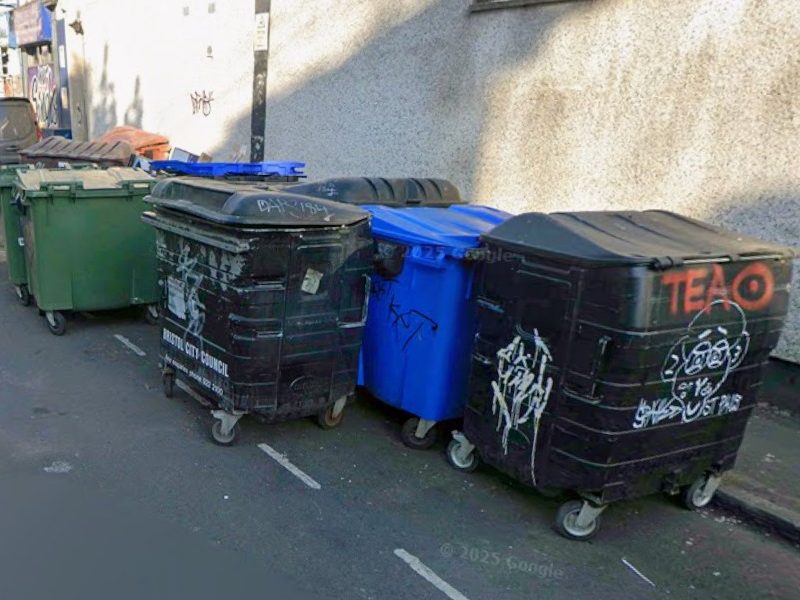
St Pauls residents are pleading with Bristol City Council to get rid of the communal bins dotted around the neighbourhood. They say the large bins attract fly-tipping and vermin and are calling on leading councillors to “not let St Pauls become the UK’s first green slum”.
The communal bins were first rolled out 15 years ago after concerns that the pavements did not have enough space for individual wheelie bins, which were “overcrowded and untidy”. So these were replaced with “mini-recycling centres”, which are just large bins at the end of the street.
However campaigners say the communal bins have led to much less recycling and more vermin, such as seagulls. Council bosses said during the environment policy committee on February 26 they would try to remove the communal bins, “where they can” .
Pavlos Kyriacou, a local resident, said: “Why was St Pauls treated differently from other areas? Why was a failed experiment allowed to persist for so long? Please don’t let St Pauls become the UK’s first green slum. We have become the land that time forgot. If you place a skip at the end of a residential street, people will fill it. If you empty it twice a week, you create a culture.”
He added that the communal bins were leading to residents throwing away more rubbish rather than recycling. This means that materials that could be recycled are instead sent to energy-from-waste plants, where they are incinerated and converted into electricity.
Tara Miran, another resident, added: “We’ve been campaigning, as the Better Streets campaign, for almost two years. We brought the rubbish in our area and did an exhibition right next door, and invited everyone in the council and Bristol Waste to come and see what we have to live like.
“Communal bins and uncollected waste in St Pauls are contributing to vermin, odour, unsafe pavements, and poorer mental health and wellbeing.”
Last year the committee carried out a major review of the recycling service, but this covered houses putting out boxes and sacks, as well as collecting black bins for general waste every three weeks instead of two. This review didn’t cover the communal bins in St Pauls.
But there is extra cash planned for clearing up fly-tipping, which is a problem in the area. Another plan is a collection service for places like flats above shops on busy roads, where residents will be given sacks to leave their rubbish in, as often space for normal bins is lacking. This will be rolled out in parts of St Pauls where council bosses think it’s “operationally feasible”.
Ken Lawson, the council’s head of waste, said: “I’m expecting the review this month to come back from Bristol Waste, to see how we can improve and reduce the number of large communal bins on the streets — and then with some long-term recommendations for how we could get rid of them entirely, or formalising some of the arrangements like you would have in blocks of flats.
“All the skips, as you call them, we will be looking to get rid of them where we can.”
Since the communal bins service was introduced in 2011, the number of homes in the area has shot up from 2,500 to 4,000, partly as large houses are converted into smaller flats. The council is also exploring whether landlords could be held accountable for placing bins on their properties instead of the street. Options will be presented to councillors in the summer.
Green Councillor Izzy Russell, who represents the Ashley ward and sits on the committee, apologised for telling residents that the communal bins would be reviewed by the task group for recycling containers and three-weekly bin collections. They said: “They weren’t, clearly. It turns out that there’s way more services than I thought within Bristol Waste.”
They added: “It is taking longer than I thought. But it is on our agenda and I do want to get rid of them. More is happening behind the scenes. I’m really sorry that it hasn’t happened sooner.”
By Alex Seabrook, Local Democracy Reporting Service